
Ishan Ayurvedic Medical College & Research Centre
Department of Rachana Sharir syllabus

Rachana Sharir Syllabus – BAMS First Professional

NCISM curriculum for Rachana Sharira (Human Anatomy) — paper-wise topics with teaching hours, practicals, assessment pattern and reference books.

Professional Year
I BAMS (First Professional)
NCISM Subject Code
AyUG-RS
Theory Papers
2
Teaching Hours
500 Hours
Total Marks
400 Marks

About the Rachana Sharir Syllabus

Department of Rachana Sharir covers Rachana Sharira (AyUG-RS) in the First Professional year of BAMS (Ayurvedacharya). The syllabus below follows the curriculum prescribed by the National Commission for Indian System of Medicine (NCISM): the topic list of every paper with its teaching hours, followed by practicals, the assessment pattern and reference books.

Rachana Sharira (Human Anatomy)

The primary purpose for teaching Rachana sharir to undergraduate students is to provide a thorough understanding of the basic principles of Sharir. G ross and microscopic structure and development of the human body in perspective of ancient and modern sciences, as well as to acquire necessary skills. Sharir in Ayurveda also provides in depth views to concepts like Marma and srotas. Learning of Sharir is most useful in further years in diagnosis and management of the diseases.
From the preface of the NCISM AyUG-RS curriculum
SubjectRachana Sharira (Human Anatomy)
NCISM subject codeAyUG-RS
Professional yearI BAMS (First Professional)
Theory papers2 (200 marks)
Teaching hours500 hours (Lecture 180, Non-lecture theory 80, Non-lecture practical 240)
Total marks400 (Theory 200 + Practical/clinical assessment 200)
ApplicabilityApplicable from 2021-22 batch onwards for 5 years or until further notification by NCISM, whichever is earlier
SourceNCISM curriculum document (49 pages)

Papers in Rachana Sharira

PaperTopicsLecture Hours
Paper I1590
Paper II1590

Rachana Sharir Paper I Syllabus

Paper I of Rachana Sharira (AyUG-RS) has 15 topics with 90 lecture hours as listed in Table 2 of the NCISM curriculum (PDF page 6).

LH – lecture hours; NLH – non-lecture hours.

1.Shariropkramaniya Shaarira

Term ILH 4NLH 2
  • Sharir and Shaarir vyakhya (definitions of sharira and sharira)
  • Shadangatvam (Six regions of the body)
  • Anga Pratyanga vibhaga (subdivisions)
  • Sharir shastra vibhag
  • Sharir gyan prayojan and its description in contemporary science with its clinical importance
2.Paribhasha Shaarira

Term ILH 3NLH 1
  • Kurcha, Kandara, Jala, Asthisamghata, Seemnta, Seevani, Rajju, and lasika
  • Terminologies related shadang sharir

3.Garbha Shaarira

Term ILH 17NLH 5
  • Garbha Vyakhya (Definition of Garbha)
  • Concept of Shukra and Artava
  • Garbhavkranti. Masanumasik grabhavruddhi
  • Role of panchamahabhoot in Garbhavruddhi
  • Concept of Beeja, Beejabhaga, Beejabhagavayava
  • Garbhposhana
  • Apara nirmiti, Garbhanabhinadi
  • Garbha Angapratyanga utpatti according to different Acharya
  • Garbha Vikruti

4.Asthi Shaarira

Term ILH 2NLH 1
  • Enumeration of Asthi, Types, asthi swaroopa, with its applied aspect

5.Sandhi Shaarira

Term IILH 2NLH 3
  • Description of Sandhi and its enumeration,
  • Types of Sandhi with its clinical importance
  • Introduction of diseases of Sandhi explained in Ayurveda

6.Snayu sharir

Term IILH 2NLH 1
  • Concept of Snayu and its clinical importance

7.Peshi Shaarira

Term IILH 2NLH 1
  • Description of Peshi,
  • Utpatti, types, Swaroop, function with its importance

8.Kesha, Danta, Nakha Sharir

Term IILH 2NLH 1
  • Description of Panchbhautik swaroop and its applied value
  • Explanation of its swabhava (Pitruja) and its applied value
  • Description of Prakrita (normal) and Vikruta(abnormal) Swaroop (appearance) of kesha, danta, nakha in concern with disease
  • Importance of examination of kesha, danta, nakha as diagnostic tool

9.Embryology

Term ILH 7NLH 2
  • Definitions and branches of embryology
  • Embryo and Fetus. Sperm and Ovum, Fertilization, Cleavage
  • Germ layers formation and their derivatives
  • Laws of heredity, Sex determination and differentiation, Month-wise development of embryo
  • Fetal circulation, Placenta formation, Umbilical cord formation

10.Osteology

Term ILH 9NLH 6
  • Bone: structure, types and ossification
  • Description of each bone with clinical anatomy

11.Arthrology

Term IILH 10NLH 6
  • Joints: structure, types and movements
  • Description of joints of extremities, inter-vertebral joints and temporomandibular joint with their clinical anatomy

12.Myology

Term IILH 6NLH 2
  • Structure and types of muscles. Description of important muscles: origin, insertion, actions, nerve supply and clinical anatomy
  • Muscle movements in Yogasana

13.Nervous System

Term IIILH 14NLH 4
  • Nervous system: Introduction and classification
  • Meninges
  • Description of Brain and Spinal cord
  • Description of Peripheral Nervous System: Cranial and Spinal nerves, Brachial, Cervical, Lumber and Sacral nerve plexus,
  • Anatomical consideration of Autonomic Nervous System,
  • Formation and circulation of cerebrospinal fluid
  • Blood supply of Brain and Spinal cord

14.Endocrinology

Term IIILH 8NLH 3
  • Description of endocrine glands (Pituitary, Thyroid, Parathyroid, Thymus, Pineal and Suprarenal glands) with clinical aspects
  • Histology of all glands

15.Lymphatic system

Term IIILH 2NLH 2
  • Introduction Structure included in lymphatic system: Lymph vessels, Lymph nodes, Lymph glands with their clinical importance

Rachana Sharir Paper II Syllabus

Paper II of Rachana Sharira (AyUG-RS) has 15 topics with 90 lecture hours as listed in Table 2 of the NCISM curriculum (PDF page 8).

LH – lecture hours; NLH – non-lecture hours.

1.Pramana Sharira

Term IILH 2NLH 1

Anguli pramana & Anjali praman with its applied importance

2.Koshtha Evam Ashaya Sharira

Term ILH 2NLH 1
  • Definition of Kostha with its applied importance and
  • Enumeration of Koshthanga and its description
  • Concept of Ashaya with its clinical importance

3.Sira Sharir

Term IILH 3NLH 1
  • Concept of Sira
  • Nirukti, types, enumeration of Sira and its applied aspect
  • Introduction to Sira vedha

4.Dhamani Sharir

Term IILH 2NLH 1
  • Concept of Dhamani
  • Nirukti, types, enumeration of Dhamani and its applied aspect

5.Strotas Shaarira

Term IILH 8NLH 3
  • Concept of Strotas
  • Nirukti, types, number of Srotas, Strotomool and its applied aspect
  • Types of Strotas and its description
  • Applied aspect of Strotas

6.Kala Shaarira

Term IIILH 2NLH 2
  • Definition and etymology of Kala
  • Enumeration and description of Kala
  • Applied aspect of Kala

7.Indriya Shaarira

Term IIILH 3NLH 1
  • Definition of Indriya, Indriya artha and Indriya adhisthan,
  • Number and importance of Indriya
  • Description of Gyanendriya, Karmendriya and Ubhayendriya (Manas)
  • Ayurved sharir of Indriya adhistan- Karna, Twacha, Netra, Jivha, Nasa
  • Applied aspect of Indriya

8.Twacha Sharir

Term IIILH 2NLH 2
  • Definition, types and characteristics of Twacha with its clinical importance, significance of Twacha adhisthana in disease manifestation, its relation with Dhatu

9.Marma Sharira

Term IILH 13NLH 4
  • Marma: definition, enumeration, classification, location
  • Surface demarcation of Marma
  • Explanation of Trimarma
  • Detail description of Marma with its applied importance

10.Respiratory System

Term IILH 6NLH 4
  • Bronchial tree and Lungs with their clinical aspects
  • Respiratory tract: Nasal cavity, Pharynx, Larynx, Trachea
  • Pleura with its clinical aspects
  • Diaphragm and its opening
  • Histology of all organs

11.Digestive system

Term ILH 10NLH 6
  • Regions of abdomen
  • Organs of digestive tract (alimentary tract) with their clinical aspects
  • Digestive glands: Liver, Spleen and Pancreas
  • Description of peritoneum with its clinical aspects
  • Histology of all organs

12.Cardiovascular system

Term IILH 8NLH 3
  • Description of Heart
  • Structure of artery & vein
  • Importance blood vessels with their course and branches
  • Pericardium with applied aspect
  • Histology of Heart

13.Urinary System

Term IILH 8NLH 3
  • Urinary tract: Kidney, Ureter, Urinary Bladder and Urethra with their clinical aspects
  • Histology of all organs

14.Reproductive system

Term IIILH 7NLH 3
  • Male Reproductive system: Reproductive organs, Scrotum and glands (Testis, Prostate and Seminal vesicles) with their clinical aspects
  • Female reproductive system: Introduction of external genital organ in brief and internal reproductive organs in detail, tract and glands with clinical importance
  • Histology of all organs

15.Sensory organs

Term IIILH 14NLH 5
  • Description of structures of Eye, Ear, Nose, Tongue and Skin with their clinical aspects

Rachana Sharir Practicals and Non-Lecture Activities

List of Practicals

10 practicals are listed in the NCISM curriculum.

No.PracticalTermHours
1Branches of anatomy. History of AnatomyI—
2Anatomical TerminologiesI—
3Preservation methods of the cadaver, Mrut sharir SamshodhanI—
4Introduction of Anatomy Act and Brief detailing about Bio medical waste management act 1960I2
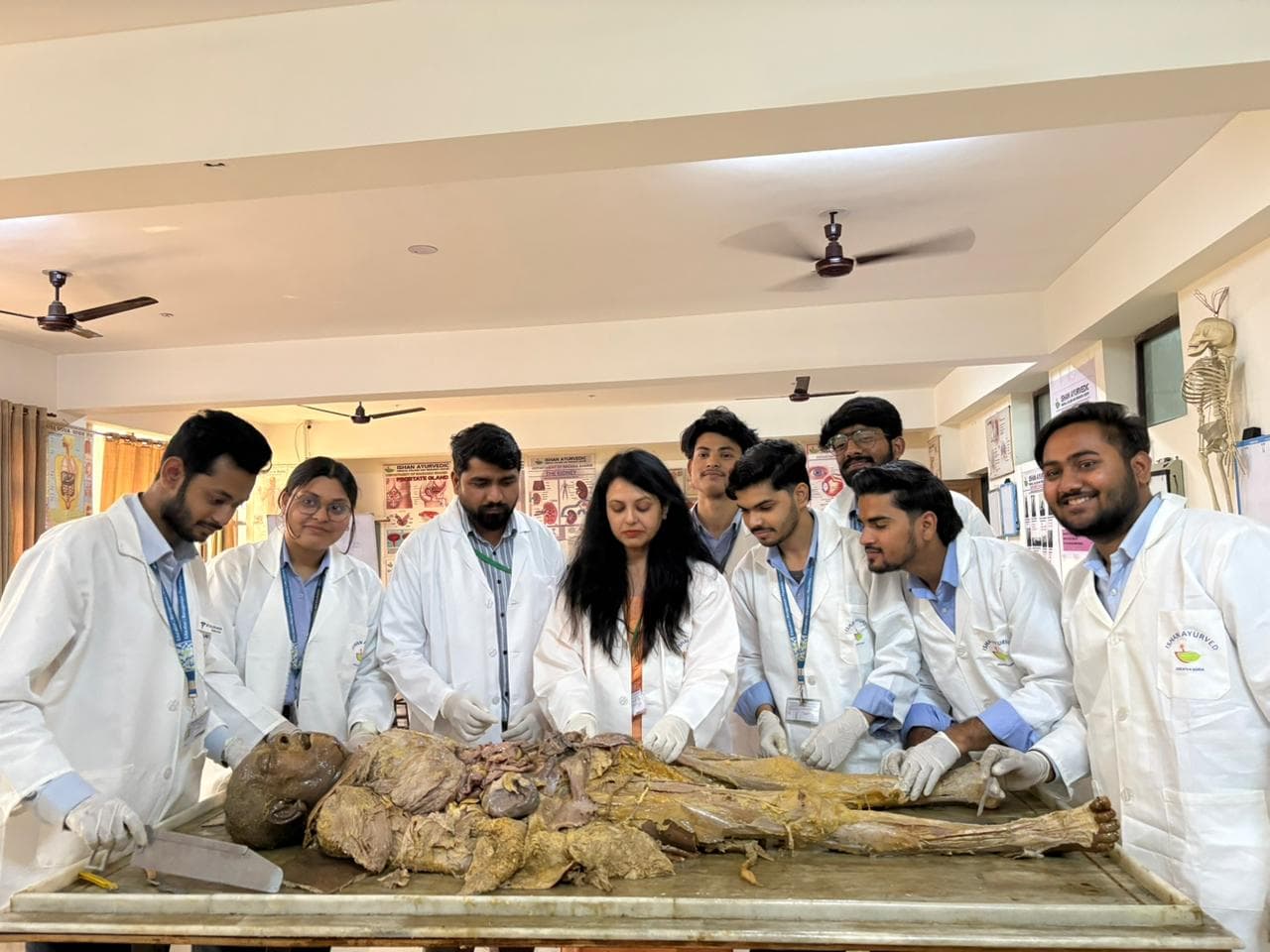
5Shava vichhedana – detailed dissection of the whole bodyI—
6Practical study of vital organs, Histological slidesII—
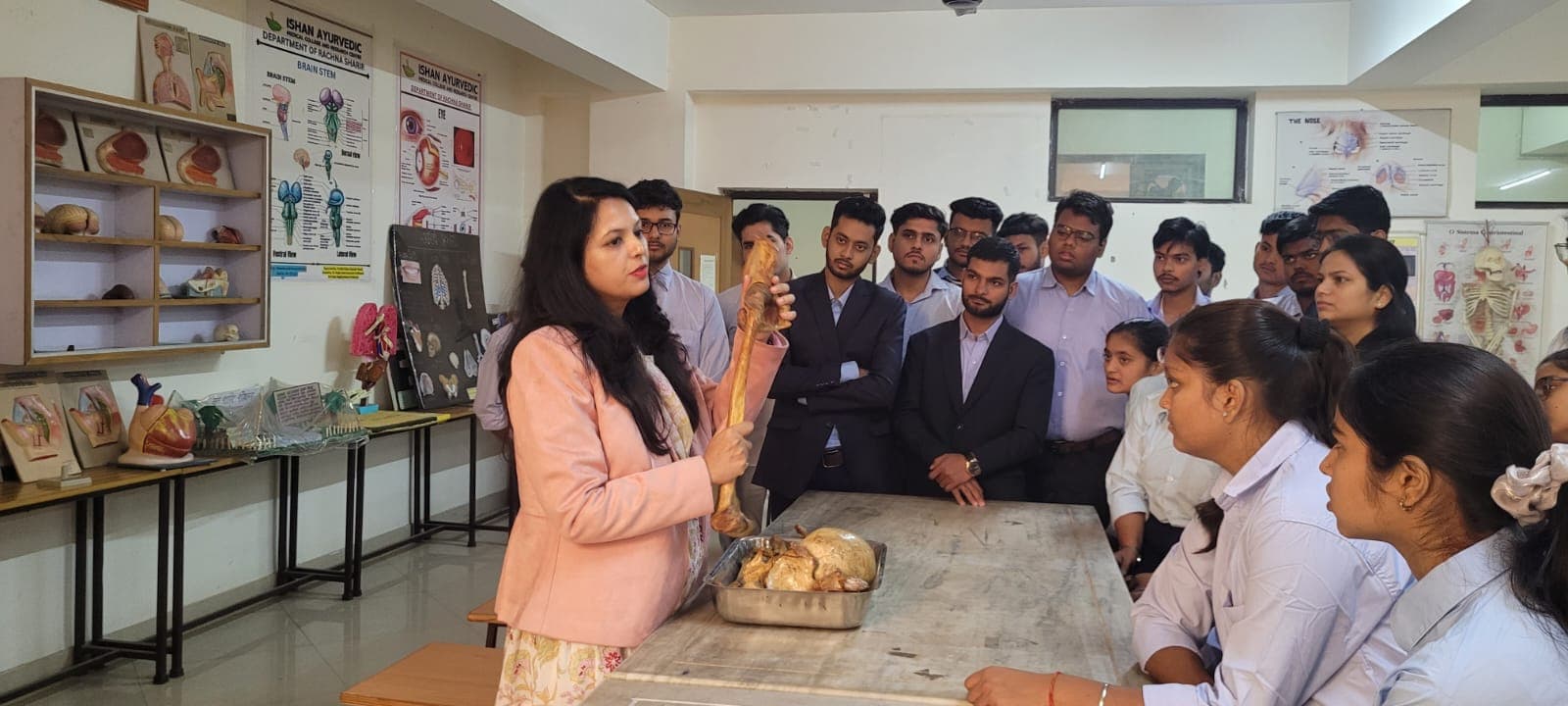
7Practical study of bonesI—
8In Surface Anatomy SectionIII—
9Practical study of MarmaIII—
10Brief detailing about body donation, organ donation and its awarenessIII—

Details of each practical and the non-lecture activities are given in the NCISM document. Open page 40 of the PDF

Rachana Sharir Assessment Pattern and Marks

Papers and Marks Distribution

PapersTheoryPracticalVivaElectiveInternal AssessmentTotal
220010070—30400

Theory carries 200 marks and the practical/clinical assessment (practical, viva, elective and internal assessment) carries 200 marks, for a total of 400 marks.

Theory Question Paper Pattern (per paper)

Question TypeQuestionsMarks EachTotal
Multiple Choice Questions (MCQ)20120
Short Answer Questions (SAQ)8540
Long Answer Questions (LAQ)41040

The head-wise distribution of the 200-mark practical examination is given in Table 6H of the NCISM document. Open page 47 of the PDF

Topic-wise learning objectives — with domain, must/desirable/nice-to-know level, teaching–learning methods and assessment methods — are tabulated in Table 3 of the NCISM document. Open pages 10–31

Rachana Sharir Reference Books

21 books and resources are recommended in the NCISM AyUG-RS curriculum (PDF page 49).

  1. Parishadhya Shabdarth Sharir
  2. Pratyaksha shaririram
  3. Sharisthana of all Samhita
  4. Sushrut Samhita Sharirshtana- Dr. Bhaskar Govind Ghanekar
  5. Brihat Shariram Vaidyaratna- P.S. Varrier
  6. Abhinava Shariram- Acharya Damodar Sharma Gaur
  7. Manava Sharir (Revised Edition)- Prof. Dinkar Govind Thatte
  8. Sharir Rachana Vigyan (English)- Vaidya P.G. Athawale
  9. Manual of Practical Anatomy Cunnigham Practical Manual Vol-1, Vol-2, Vol-3
  10. Clinical Anatomy in Ayurveda - Prof. D.G. Thatte & Prof. Suresh Chandra
  11. Ayurvedic Human Anatomy - Prof. Dr. Giridhar M. Kanthi
  12. Sharir Rachana Vigyan Vol I & II – Dr. Sunil Kumar Yadav
  13. Regional Anatomy - B. D. Chaurasia
  14. Rachana Sharir Vigyana - Dr. Mahendra Sing
  15. Relevant chapters of Brihtrayee and Laghuthrayee
  16. Gray's Anatomy
  17. Text Book of Human Anatomy- Inderbir Singh
  18. Clinical Anatomy- Richard S Snell
  19. Fundamentals of Human Anatomy- Dr. Chakraborthy
  20. Human Osteology - Poddar
  21. A Handbook of Anatomical Terminology, Dr. Nidhi Shrivastava, Dr. Ravi Kumar Shrivastava, Dr. Rakesh Kumar Sharma

Download Rachana Sharir Syllabus PDF

The syllabus on this page is taken from the official NCISM curriculum document. Download the PDF for the complete learning objectives, activity details, question paper blueprint and practical examination guidelines.

Rachana Sharir Syllabus FAQs

Rachana Sharira (Human Anatomy) has the NCISM subject code AyUG-RS. It is a First Professional BAMS (I BAMS) subject, and the curriculum is applicable from 2021-22 batch onwards for 5 years or until further notification by NCISM, whichever is earlier.

It has 2 theory papers carrying 200 marks and a practical/clinical assessment of 200 marks (100 practical, 70 viva and 30 internal assessment), for a total of 400 marks.

The NCISM curriculum allots Rachana Sharir 500 teaching hours: 180 lecture hours, 80 non-lecture theory hours and 240 non-lecture practical hours.

Paper I has 15 topics, including Shariropkramaniya Shaarira, Paribhasha Shaarira, Garbha Shaarira, Asthi Shaarira, Sandhi Shaarira and Snayu sharir. Paper II has 15 topics, including Pramana Sharira, Koshtha Evam Ashaya Sharira, Sira Sharir, Dhamani Sharir, Strotas Shaarira and Kala Shaarira.

The NCISM curriculum lists 21 reference books and resources for Rachana Sharir. The complete list is given in the Reference Books section of this page.

Students at Ishan Ayurved
Enquire Now

Ready to Join BAMS?

Take the first step towards your dream career. Enquire Now or contact us for more information.

Contact Us