Rasa (Taste)
Tikta, Kashaya
The primary taste perceived on the tongue.

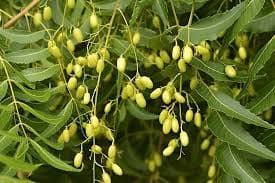
Nimba is a fast-growing tree that can reach a height of 15–20 metres .
Azadirachta indica · Meliaceae
Nimba is a fast-growing tree that can reach a height of 15–20 metres .
Scientific Name
Azadirachta indica
Family
Meliaceae
Hindi Name
Neem
Used Part
Patra (Leaf), Twak (Bark), Bija (Seed), Phala (Fruit), Pushpa (Flowers) and Niryasa (Resin).
Morphology and field-identification notes as documented in our Dravyaguna library.
Nimba is a fast-growing tree that can reach a height of 15–20 metres . It is evergreen, shedding many of its leaves during the dry winter months . The branches are wide and spreading. The leaves are opposite, pinnate, 20–40 cm long, with 20 to 30 medium to dark green leaflets about 3–8 cm long with short petioles. Flowers are white and fragrant arranged in more-or-less drooping axillary panicles. The fruit is a smooth, glabrous, olive-like drupe which varies in shape from elongate oval to nearly roundish.
The five-fold framework Ayurveda uses to describe a drug — Rasa, Guna, Vipaka, Veerya and its effect on the doshas.
Tikta, Kashaya
The primary taste perceived on the tongue.
Laghu
Physical and energetic attributes of the dravya.
Katu
Taste that emerges after complete digestion.
Pitta Kapha Shamaka
Effect on Vata, Pitta and Kapha doshas.
Sheeta
Heating (ushna) or cooling (sheeta) energy.
Kushthaghna, Arshoghna, Krimighna, Bhedana, Mehahara and Gulmanashaka.
How modern science maps onto the classical understanding of this dravya.
Pharmacological Action
Insect repellent, Blood purifier, Antidiabetic, Antiviral, Antibacterial.
Phytoconstituents
Nimbin, Nimbinene, Nimbandiol, Nimbolide, Quercitin, g-sitosterol, Azadirone, Azadiradione
Classical Ayurvedic indications drawn directly from the Dravyaguna tradition — paired with the preparations recommended in shastra.
01
Decoction of Nimba is used internally in case of Surameha.
02
Paste prepared from Nimba and Aragwadha is applied in skin diseases.
03
In case of Arumshika (Head boils), first, blood letting should be done then decoction of Nimba is sprinkled over the head boils.
04
Affected part of skin of wounded and eaten by maggots, is cleaned and Nimba and Vidanga powder is mixed with cow's urine and applied.
Always consult a qualified Ayurvedic physician before using any herb therapeutically. Dose, anupana and Prakriti-specific suitability matter.
Yoga / Kalpana
Common Ayurvedic preparations where Nimba is a key ingredient.
Shastra Pramana
निम्बः शीतो लघुः ग्राही कटुः तिक्तो अग्नि वातकृत् । अहृयः श्रम तृट् कास ज्वर अरुचि कृमिप्रणुत् ॥ व्रणपित्त कफच्छर्दि कुष्ठ हल्लास मेहनुत् ।