Rasa (Taste)
Tikta, Katu
The primary taste perceived on the tongue.

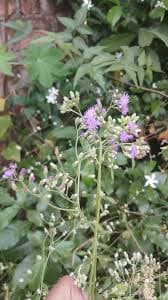
BOTANICAL DESCRIPTION The Sahadevi plant is a herbaceous annual or perennial plant that is commonly found in various parts of India and other tropical regions.
Vernonia cinerea · Asteraceae
BOTANICAL DESCRIPTION The Sahadevi plant is a herbaceous annual or perennial plant that is commonly found in various parts of India and other tropical regions.
Scientific Name
Vernonia cinerea
Family
Asteraceae
Hindi Name
Sahadevi
Used Part
Whole plant, Root
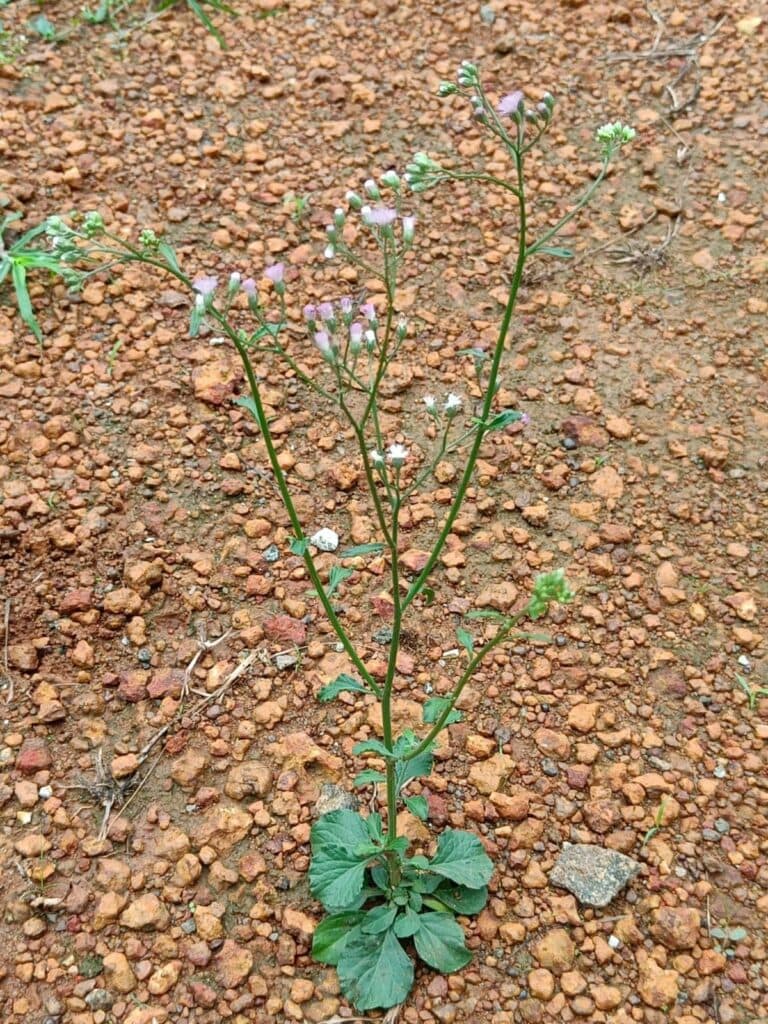
Morphology and field-identification notes as documented in our Dravyaguna library.
BOTANICAL DESCRIPTION
The Sahadevi plant is a herbaceous annual or perennial plant that is commonly found in various parts of India and other tropical regions. It typically grows to a height of 30-60 cm and has an upright, branching stem. The leaves of Sahadevi are lance-shaped, serrated, and covered in fine hairs, giving them a slightly grayish-green appearance. The plant produces small, tubular flowers that are purple or pink in color and are clustered in terminal heads
The five-fold framework Ayurveda uses to describe a drug — Rasa, Guna, Vipaka, Veerya and its effect on the doshas.
Tikta, Katu
The primary taste perceived on the tongue.
Tikshna
Physical and energetic attributes of the dravya.
Katu
Taste that emerges after complete digestion.
Kaphapitta shamaka
Effect on Vata, Pitta and Kapha doshas.
Sheeta
Heating (ushna) or cooling (sheeta) energy.
Jwarghna, Krimighna, Pandughna
How modern science maps onto the classical understanding of this dravya.
Pharmacological Action
Antipyretic, Anti inflammatory, Analgesic, Hepatoprotective.
Phytoconstituents
Sahadevi contains several bioactive compounds, including alkaloids, flavonoids, terpenoids, and tannins. Vernonioside A and B are two major sesquiterpene lactones found in the plant.
Classical Ayurvedic indications drawn directly from the Dravyaguna tradition — paired with the preparations recommended in shastra.
01
Fever – Decoction (kadha) of the whole plant is given in small amounts.
02
Swelling – Paste of fresh leaves is applied externally on swollen areas.
03
Wounds/Skin problems– Leaf paste is applied over wounds or skin eruptions.
04
Worm infestation – Decoction of the plant is traditionally used internally in small quantity.
05
Insect bites/poisonous bites – Fresh leaf paste is applied on the bite area.
Always consult a qualified Ayurvedic physician before using any herb therapeutically. Dose, anupana and Prakriti-specific suitability matter.
Yoga / Kalpana
Common Ayurvedic preparations where Sahadevi is a key ingredient.
Shastra Pramana
दण्डोत्पला सहदेवी विषमज्वरनाशिनी । सहदेवी द्विधा प्रोक्ता श्वेता नीला व पुष्पत द्वयं चैकान्तरं हन्ति भषणात् धारणादपि । निद्राकरा छता शीर्षे नीला सिध्मविनाशिनी