Rasa (Taste)
Katu ,Tikta
The primary taste perceived on the tongue.

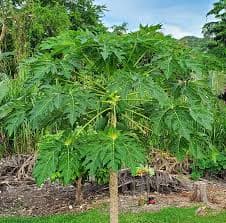
It is large plant having height 20-30 feet.
Carica papaya · Caricaceae
It is large plant having height 20-30 feet.
Scientific Name
Carica papaya
Family
Caricaceae
Hindi Name
Papita
Used Part
Fruit, Leaf, Latex, Seed.
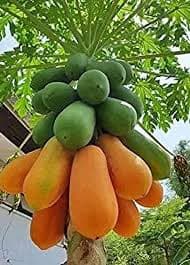
Morphology and field-identification notes as documented in our Dravyaguna library.
It is large plant having height 20-30 feet. Leaves are palmately lobed. Stem are hollow, tan brown and light green in colour, having a diameter of 8-10 inches. Fruit are oval in shape, filled with central seed cavity, weight of fruit is about 1 to 3 kg. And papaya color is green, on being ripe it turns to yellow or red orange.
The five-fold framework Ayurveda uses to describe a drug — Rasa, Guna, Vipaka, Veerya and its effect on the doshas.
Katu ,Tikta
The primary taste perceived on the tongue.
Laghu, Ruksha, Tikshna.
Physical and energetic attributes of the dravya.
Katu
Taste that emerges after complete digestion.
Kaphavatahara
Effect on Vata, Pitta and Kapha doshas.
Ushna
Heating (ushna) or cooling (sheeta) energy.
Hridya, Grahi, Lekhana, Shothahara, Vednasthapana.
How modern science maps onto the classical understanding of this dravya.
Pharmacological Action
Anti-Inflammatory & Antioxidant, Antimicrobial & Antifungal, Wound Healing.
Phytoconstituents
Carotenoids, Primarily beta-carotene, precursor to vitamin A, vitamin C and Folate.
Classical Ayurvedic indications drawn directly from the Dravyaguna tradition — paired with the preparations recommended in shastra.
01
Leaves of Papaya are crushed in a clean mortar and pestle and juice is extracted. 15 – 30 ml of this juice is mixed with equal or double quantities of water and administered once or twice a day for the treatment of Dengue.
02
The leaves of the Papaya plant are slightly heated and applied locally over the part of the body to relieve pain and swelling.
Always consult a qualified Ayurvedic physician before using any herb therapeutically. Dose, anupana and Prakriti-specific suitability matter.
Yoga / Kalpana
Common Ayurvedic preparations where Erandkarkati (Papaya) is a key ingredient.
Shastra Pramana
एरण्डकर्कटी लघ्वी तीक्ष्णां कट्वी सतिक्तका । वीर्योष्णा पाचनी हृद्या ग्राहिणी कफवातनुत् ॥ एरण्डकर्कटीच्क्षीरं पाचनं परमं स्मृतम् । फलं सतिक्तमधुरं पक्दं तु मधुरं लघु ॥ (स्व.