Rasa (Taste)
Tikta, Kashaya, Katu.
The primary taste perceived on the tongue.

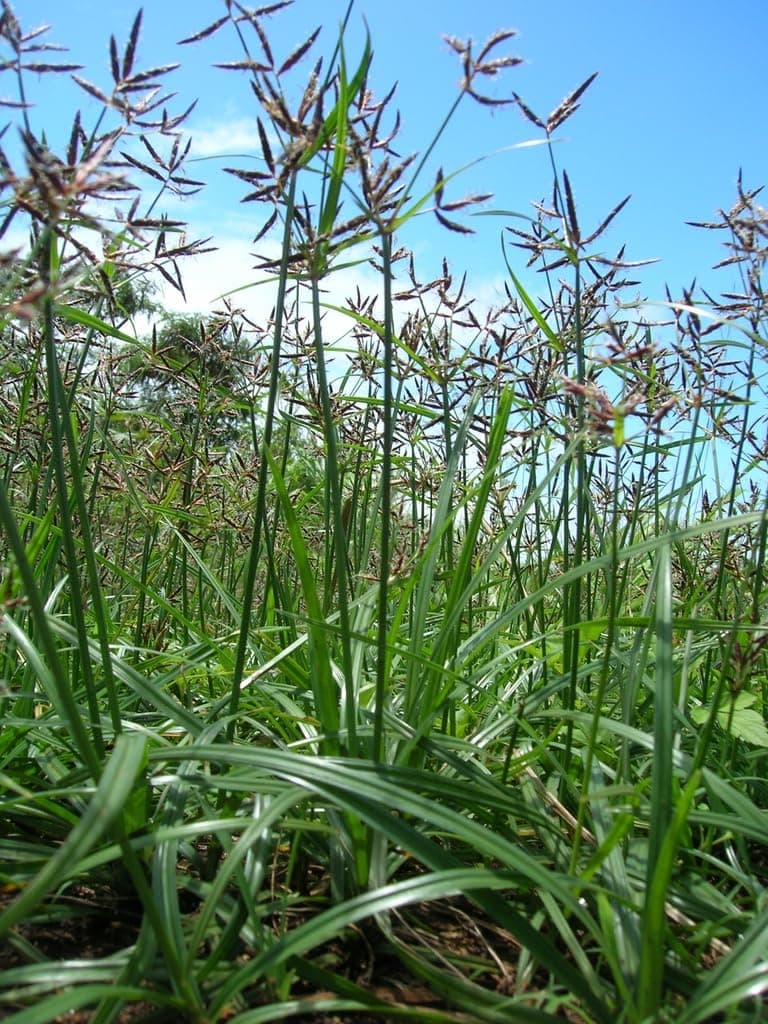
It is a colonial, perennial herb, 7–40 cm tall with fibrous roots and reproduces largely by rhizome and tubers.
Cyperus rotundus · Cyperaceae
It is a colonial, perennial herb, 7–40 cm tall with fibrous roots and reproduces largely by rhizome and tubers.
Scientific Name
Cyperus rotundus
Family
Cyperaceae
Hindi Name
Motha, Nagarmotha
Used Part
Kanda (Tuber)
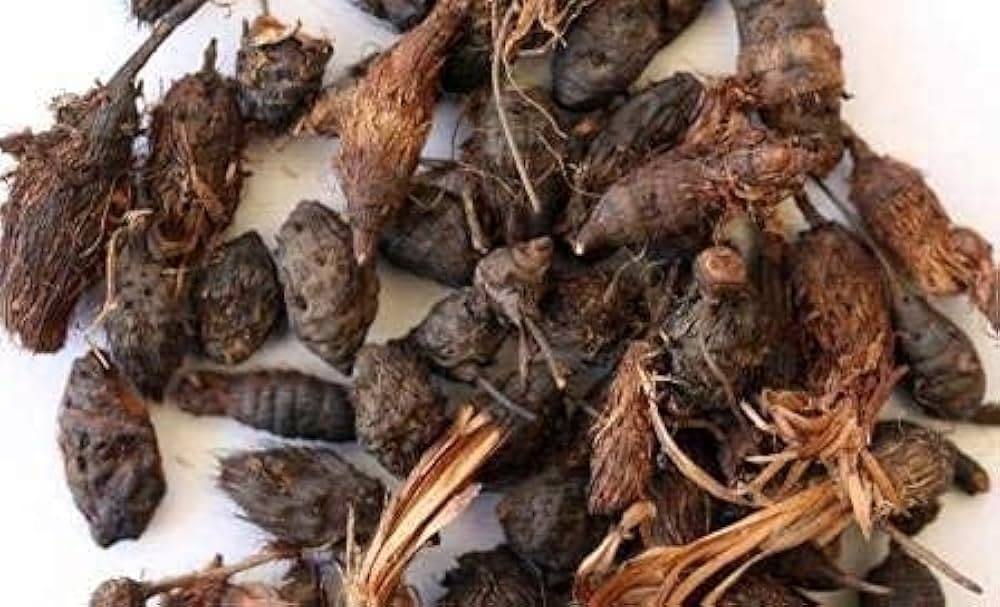
Morphology and field-identification notes as documented in our Dravyaguna library.
It is a colonial, perennial herb, 7–40 cm tall with fibrous roots and reproduces largely by rhizome and tubers. Rhizomes may grow in any direction in the soil. Those growing upward produces shoot and roots. The rhizomes that are growing downwards or horizontally form individual tubers or chains of tubers. Mature individual tubers are dark reddish-brown about 12 mm thick and vary from 10 to 35 mm long. The leaves are dark green, shiny, narrow and grass-like ranging in size from 5 to 12 mm wide to 50 cm long. The upright stems support a much-branched inflorescence with bisexual flowers.
The five-fold framework Ayurveda uses to describe a drug — Rasa, Guna, Vipaka, Veerya and its effect on the doshas.
Tikta, Kashaya, Katu.
The primary taste perceived on the tongue.
Laghu, Ruksha
Physical and energetic attributes of the dravya.
Katu
Taste that emerges after complete digestion.
Kapha pitta Shamaka
Effect on Vata, Pitta and Kapha doshas.
Sheeta
Heating (ushna) or cooling (sheeta) energy.
Deepniya, Grahi, Jvaraghna, Stanya Shodhan , Trishna Nigrahana.
How modern science maps onto the classical understanding of this dravya.
Pharmacological Action
Antioxidant.Wound healing, Anti-pyretic, Anti-diarrhoeal, Anti-allergy or Anti-histaminic activity, Anti-hyperglycemic Anti-microbial , Anti-convulsant,.
Phytoconstituents
B-selinine, cypernone, keto-alcohols, a-rotunol, b-rotunol, cineol, linolenic, linolic, oleic, myristic acid, steoric acid and glycerol
Classical Ayurvedic indications drawn directly from the Dravyaguna tradition — paired with the preparations recommended in shastra.
01
grams of coarse powder of the rhizome is taken and decoction is made. To this a pinch of ginger powder is added and administered. This cures most of the problems related to stomach and intestine.
02
Musta cure the complaint of pinworm infestation and related problems like nausea, anorexia, itching of the anus in about 10-12 days time.
03
Fine paste prepared with plaintain juice helps breast milk purification: Rhizome is taken and rubbed with plantain juice and fine paste is made. This is administered to the breast feeding mother in cases where breast milk is vitiated or the child is getting indigestion due to breast milk..
Always consult a qualified Ayurvedic physician before using any herb therapeutically. Dose, anupana and Prakriti-specific suitability matter.
Yoga / Kalpana
Common Ayurvedic preparations where Musta is a key ingredient.
Shastra Pramana
अनूपदेशे यज्जातं मुस्तकं तत्प्रशस्यते । तत्रापि मुनिभिः प्रोक्तं वरं नागरमुस्तकम् ||