Rasa (Taste)
Kashaya, Madhura, Amla
The primary taste perceived on the tongue.

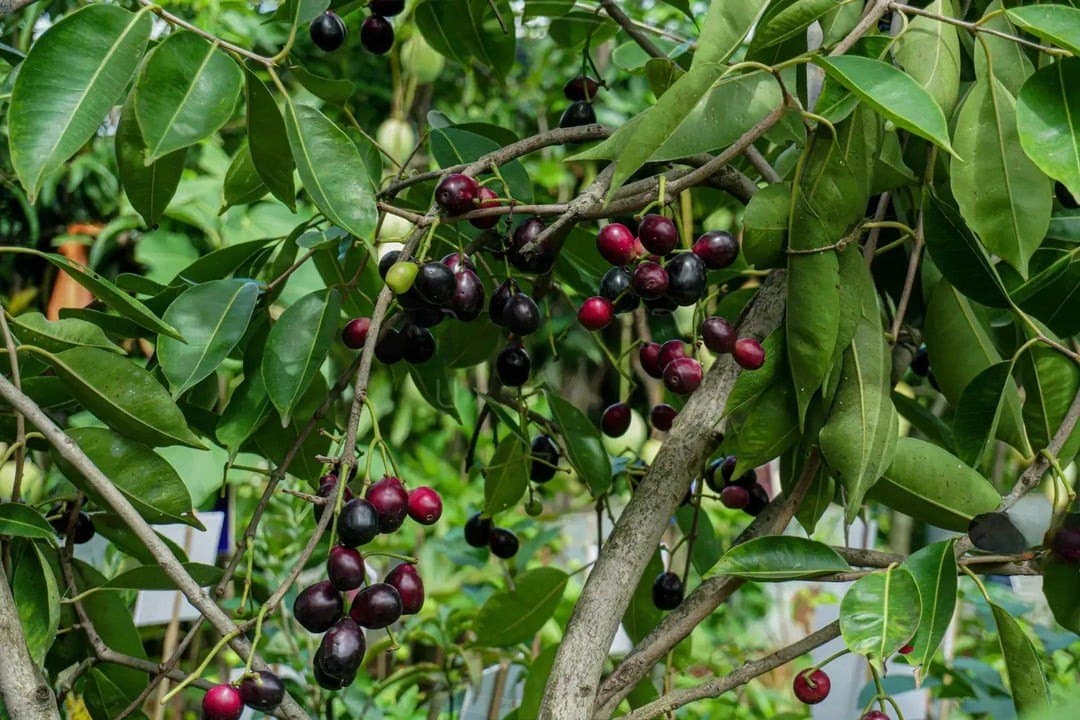
Jamun grows throughout india.
Eugenia jambolana. Lam · Myrtaceae
Jamun grows throughout india.
Scientific Name
Eugenia jambolana. Lam
Family
Myrtaceae
Hindi Name
Jamun
Used Part
Beeja (seed), Phala (fruit), Twak (Bark),Patra (leaf)
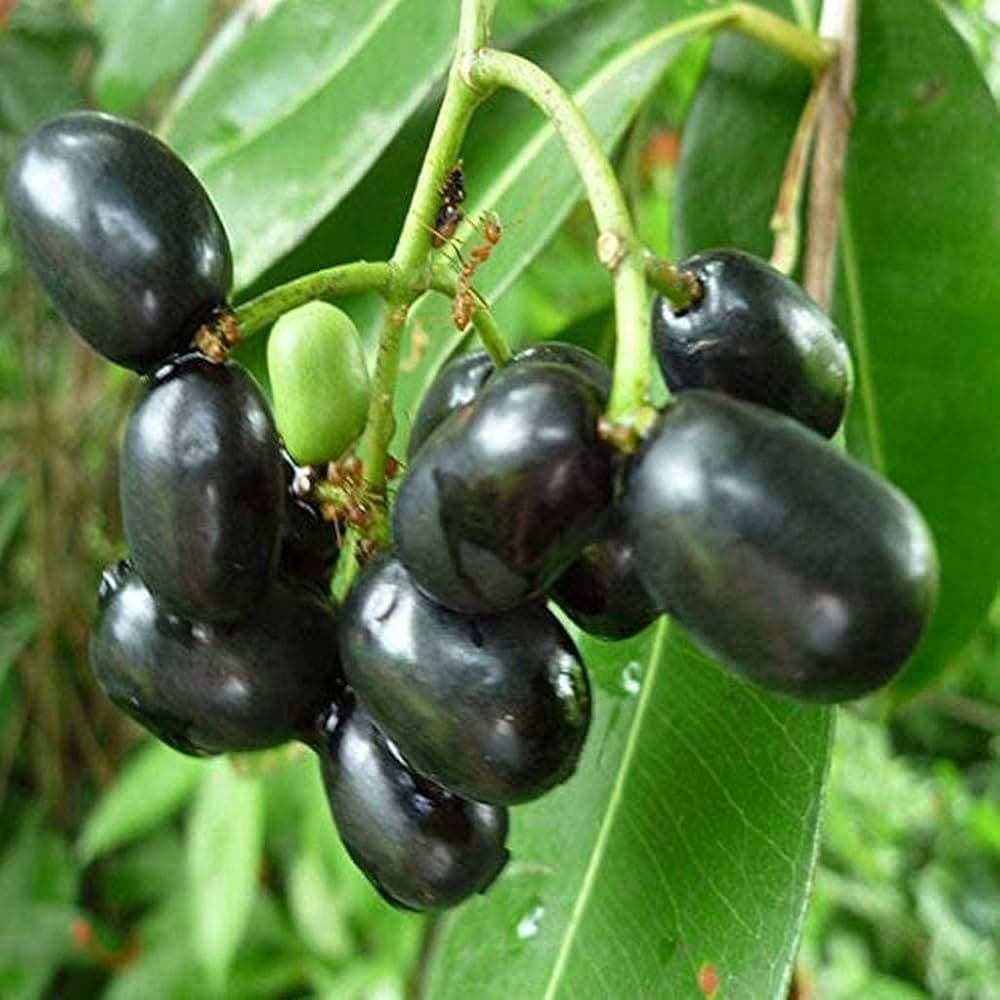
Morphology and field-identification notes as documented in our Dravyaguna library.
Jamun grows throughout india. It is also cultivated in gardens as it yield fruits and gives good shade. Habit is an evergreen tree. Roots are tap root, branched. Stems are erect, woody, branched, thick, solid, cylindrical with grey bark. Leaf are simple, opposite, stalked, ovate or ovate lanceolate, 10-12cm long and 3-4 cm wide. Inflorescence is panicle. Flower are white, small, crowded on inflorescence. Fruits are berry, succulent, globose or oblong, dark purple in Colour. Seeds are single, endospersmic.
The five-fold framework Ayurveda uses to describe a drug — Rasa, Guna, Vipaka, Veerya and its effect on the doshas.
Kashaya, Madhura, Amla
The primary taste perceived on the tongue.
Laghu,Ruksa
Physical and energetic attributes of the dravya.
Katu
Taste that emerges after complete digestion.
Kapha pitta Shamaka
Effect on Vata, Pitta and Kapha doshas.
Shita
Heating (ushna) or cooling (sheeta) energy.
Sangrahi, Kanthya, Rocana, Vistambhi , Lekhan, Sramahara, Krimighna
How modern science maps onto the classical understanding of this dravya.
Pharmacological Action
Antidiarrhoeal, Antidiabetic, Antiinflammatory, Antiviral, Antipyretic.
Phytoconstituents
Friedelin, Kaempferol, Quercitin, ẞ-sitosterol, B-D-glucoside , Glycine, Alanine, Leucine and Tyrosine , Gallic acid, Oxalic acid, Citric acid.
Classical Ayurvedic indications drawn directly from the Dravyaguna tradition — paired with the preparations recommended in shastra.
01
In case of instrinsic haemorrhage, cold infusion prepared from Jambu , Amra and Arjuna is very useful.
02
Decoction of tender leaves of Jambu and Amra is prepared. Once it is cooled add little honey and given for drink to check vomitting.
03
Decoction prepared from Jambu seed, Amra bija, Pulp of Bilva , Kapittha and Nagara. This decoction is administered with liquid gruel (for diarrhoea).
04
Fine powder is prepared from barks of Kakubha, Udumbara, Aśwattha, Lodhra, Jambu and Katphala. This powder is used for dusting over wound. It improves healing of wound.
05
Fine powder prepared from seeds of Jambu - 1 tsp to be taken every day morning. Decoction prepared from bark is also very useful in Madhumeha.
Always consult a qualified Ayurvedic physician before using any herb therapeutically. Dose, anupana and Prakriti-specific suitability matter.
Yoga / Kalpana
Common Ayurvedic preparations where Jamun is a key ingredient.
Shastra Pramana
राजजम्बू-फलेन्द्रा कथिता नन्दी राजजम्बुर्महाफला । तथा सुरभिपत्रा च महाजम्बुरपि स्मृता ॥ क्षुद्रजम्बु- क्षुद्रजम्बुः सूक्ष्मपत्रा नादेयी जलजम्बुका ।। राजजम्बुफलं स्वादु विवृम्भि गुरु रोचनम्। जम्बूः संग्राहिणी रूक्षा कफपित्तास्त्रदाहजित् ।। (भा.प्र. आम्रादि फलवर्ग 69-70)