Rasa (Taste)
Tikta, Katu
The primary taste perceived on the tongue.

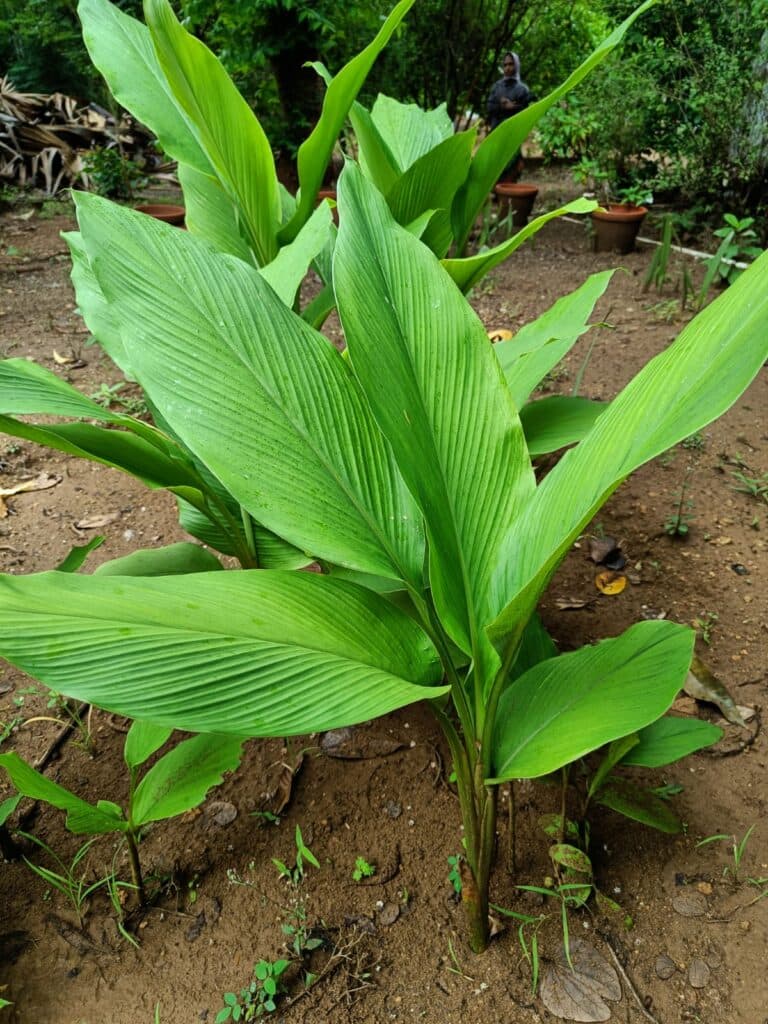
Turmeric is cultivated extensively all over India as a commerical crop.
Curcuma longa Linn. · Zingiberaceae
Turmeric is cultivated extensively all over India as a commerical crop.
Scientific Name
Curcuma longa Linn.
Family
Zingiberaceae
Hindi Name
Haldi
Used Part
Kanda (Rhizome)
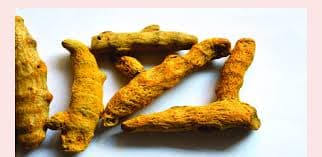
Morphology and field-identification notes as documented in our Dravyaguna library.
Turmeric is cultivated extensively all over India as a commerical crop.
It is a tall herb with large root stock , ovoid, with sessile, cylindric tubers that are orange-coloured inside.
Leaves are very large, in tufts up to 1.2 meter or longer, including the petiole which is about as long as the blade, oblong lanceolate, tapering to the base.
Inflorescence is Spike, 10-15 cm long, peduncle15 cm or more, concealed by the sheating pertiole.
Flowers are pale yellow as long as bracts. Corolla tube has funnel shaped upper half which is pinkish white in color.
The five-fold framework Ayurveda uses to describe a drug — Rasa, Guna, Vipaka, Veerya and its effect on the doshas.
Tikta, Katu
The primary taste perceived on the tongue.
Ruksha, Laghu
Physical and energetic attributes of the dravya.
Katu
Taste that emerges after complete digestion.
Kaphapitta Shamaka
Effect on Vata, Pitta and Kapha doshas.
Ushna
Heating (ushna) or cooling (sheeta) energy.
Varnya, Twachya, Pramehahara, Shothahara, Vranahara, Kandughna, Vishaghna, Kushthaghna, Krimighna, Ruchikara, Shitapittahara.
How modern science maps onto the classical understanding of this dravya.
Pharmacological Action
Hepatoprotective, Antiallergic, Immunostimulant, Anticancer, Antitumor, Antihyperlipidemic, Antioxidant and Antimicrobial
Phytoconstituents
Rhizome ocontains 5% volatile oil, resin, abundant zingeberaceous starch grains and yellow colouring substances known as curcuminoids. Chief component of curcuminoids is known as curcumin (50-60%).
Classical Ayurvedic indications drawn directly from the Dravyaguna tradition — paired with the preparations recommended in shastra.
01
Powder of Haridra is taken with honey or Haridra and Amla mixed in equal quantity and administered is beneficial in Prameha (Diabetes).
02
Haridra powder when taken with Cow's urine and Jaggery cures Dadrukushtha (Ring worm infestation) and even Shlipada (Filariasis).
03
Kwatha of Haridra and Guduchi is taken with honey in case of Kapha dominant Vatarakta.
04
In case of Kaphaja trishna (thirst) one has to take water processed with Rajani (Haridra) mixed with honey and sugar.
05
Haridra powder is mixed with Triphala added with ghee and honey cures Panduroga (Anaemia).
Always consult a qualified Ayurvedic physician before using any herb therapeutically. Dose, anupana and Prakriti-specific suitability matter.
Yoga / Kalpana
Common Ayurvedic preparations where Haridra is a key ingredient.
Shastra Pramana
हरिद्रा काञ्चनी पीता निशाऽऽख्या वरवर्णिनी। कृमिघ्नी हलदी योषित्प्रिया हट्टविलासिनी ॥ हरिद्रा कटुका तिक्ता रूक्षोष्णा कफपित्तनुत् । वर्ष्या त्वग्दोषमेहास्त्र शोथपाण्डूव्रणापहा ॥ (भा.प्र. हरीतक्यादि वर्ग 197)