Rasa (Taste)
Madhura
The primary taste perceived on the tongue.

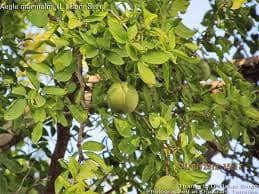
Habitat -commonly found throughout India especially in temple yard.
Aegle marmelos (L.) Correa · Rutaceae
Habitat -commonly found throughout India especially in temple yard.
Scientific Name
Aegle marmelos (L.) Correa
Family
Rutaceae
Hindi Name
Bel
Used Part
Moola (root), Patra (leaves), Pakwa phala (ripe fruit)
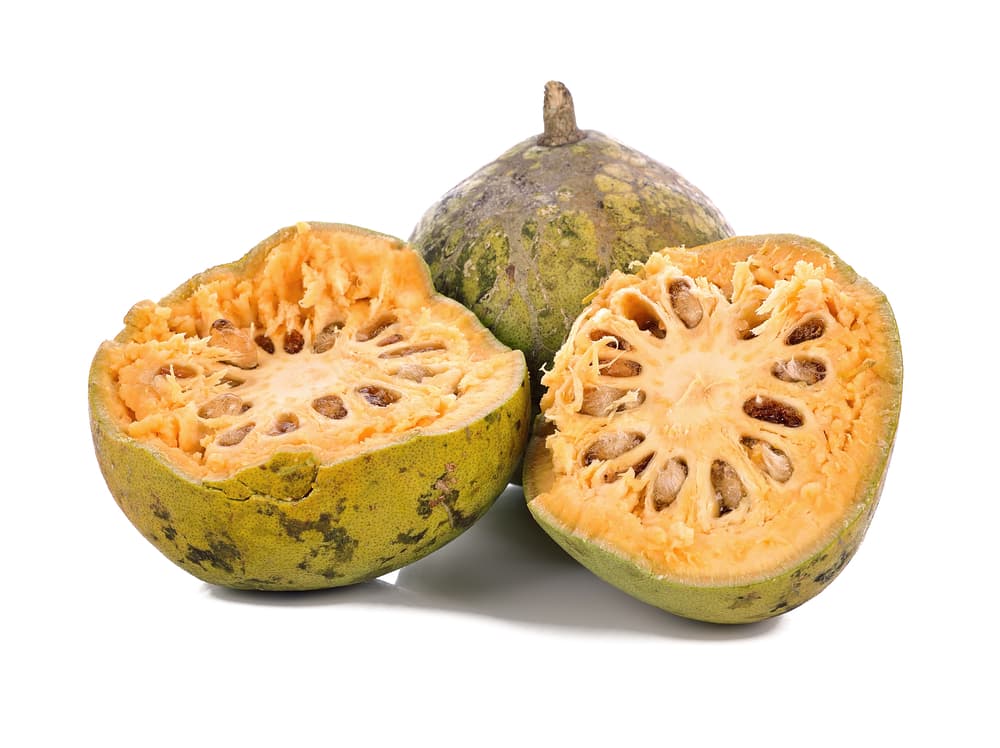
Morphology and field-identification notes as documented in our Dravyaguna library.
Habitat -commonly found throughout India especially in temple yard. Habit- A deciduous, armed tree of 8-15 mtr high. Root - tap root, branched. Inflorescence -cymose, axillary panicle. Stem - erect, branched, woody, cylindrical, solid, with axillary straight single or paired spines. Leaf- Palmately compound, trifoliate, petiolate, alternate, gland-dotted, leaflets are elliptic, lanceolate or oblong, acute, entire, glabrous, net-veined, laterals sessile, terminal one stalked. Flowers- Pedicellate, bisexual, actinomorphic, complete, hypogynous, pentamerous, sweet scented, 5 petals white in colour.
The five-fold framework Ayurveda uses to describe a drug — Rasa, Guna, Vipaka, Veerya and its effect on the doshas.
Madhura
The primary taste perceived on the tongue.
Guru
Physical and energetic attributes of the dravya.
Madhura
Taste that emerges after complete digestion.
Kaphavata shamaka
Effect on Vata, Pitta and Kapha doshas.
Sheeta
Heating (ushna) or cooling (sheeta) energy.
Mula (Root) - Shothahara, Chardighna, Shulahara. Patra (Leaf) , Apakwa phala (Unripen fruit) - Dipana, Pachana, Grahi, Hradya. Pakwaphala (Ripen fruit) – Vidahi, Agnisadaka.
How modern science maps onto the classical understanding of this dravya.
Pharmacological Action
Antidiarrhoeal , Antiulcer, Cytoprotective, Anti-inflammatory, Antibacterial, Antidiabetic, Antioxidant
Phytoconstituents
Root - Marmelosin, marmelide, tannic acid, marmin, haplopine (alkaloid). Unripen fruit has marmeline (alkaloid), aegeline (alkaloid). Ripen fruit -Contains-Xanthotoxol, ẞ-Sitosterol.
Classical Ayurvedic indications drawn directly from the Dravyaguna tradition — paired with the preparations recommended in shastra.
01
The fruit taken in the form of beverage help in the healing of peptic ulcer.
02
The juice of leaves are mixed with pepper to bring relief from wheezing cough and respiratory spasm.
03
Fresh leaf juice is traditionally consumed to promote insulin secretion, control diabetes.
04
Due to the presence of the anti-bacterial properties in Bael, it is highly effective against skin infections, cures many skin disorders .
05
Bael having a load of vitamin C acts as a boon for people suffering from Vitamin C deficiency.
Always consult a qualified Ayurvedic physician before using any herb therapeutically. Dose, anupana and Prakriti-specific suitability matter.
Yoga / Kalpana
Common Ayurvedic preparations where Bilva is a key ingredient.
Shastra Pramana
बिल्वं हृद्यं कषायं च तीक्ष्णोष्णं दीपनं गुरु।कफवातहरं ग्राहि पक्वमम्लं त्रिदोषजित्॥बिल्वमूलं त्रिदोषघ्नं शोथघ्नं बलकृत्तथा।फलं तु बालमेवात्र सङ्ग्राहि दीपनं परम्॥ (Bhav. P. Ni)