Rasa (Taste)
Katu
The primary taste perceived on the tongue.

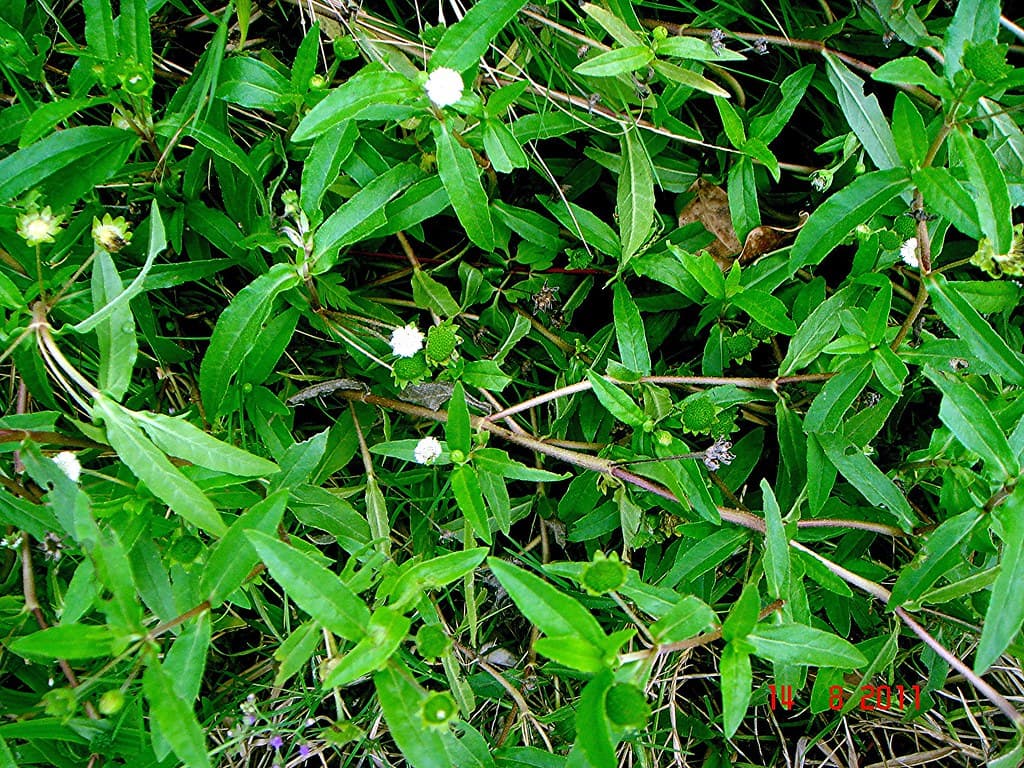
Bhringaraj is a creeping herb that grows to a height of 1 to 3 feet .
Eclipta alba · Asteraceae
Bhringaraj is a creeping herb that grows to a height of 1 to 3 feet .
Scientific Name
Eclipta alba
Family
Asteraceae
Hindi Name
Bhangra
Used Part
Panchanga
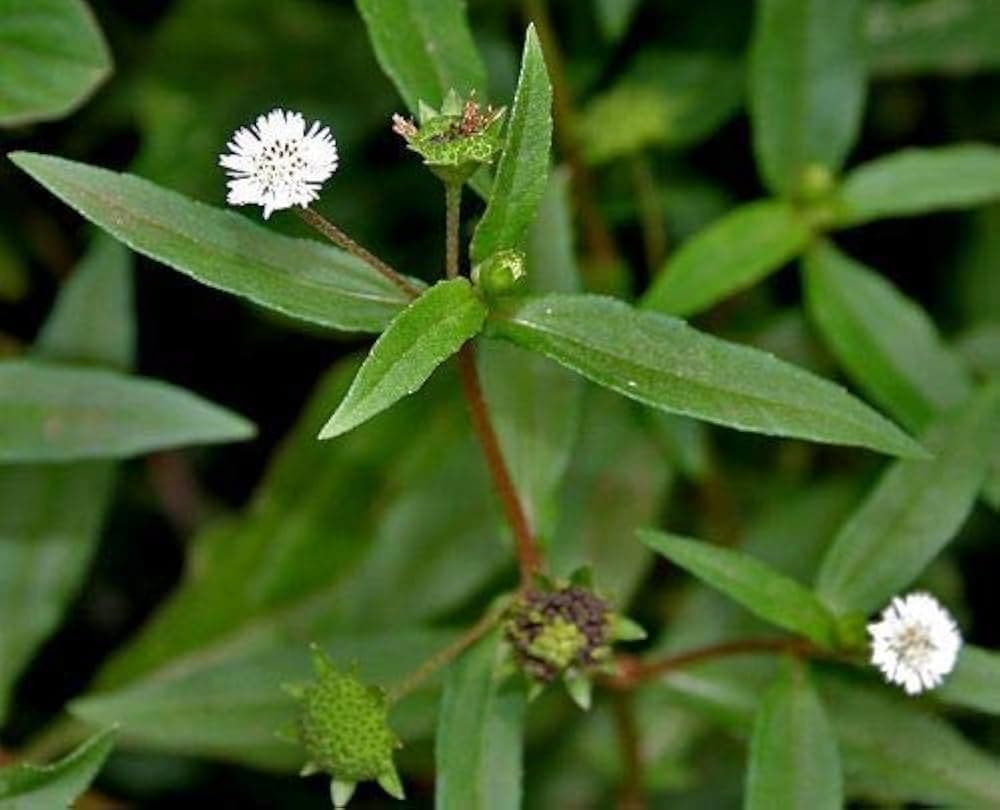
Morphology and field-identification notes as documented in our Dravyaguna library.
Bhringaraj is a creeping herb that grows to a height of 1 to 3 feet . It has a long stalk and white coloured flowers which are solitary, winged and about 6 to 8 mm in diameter. The leaves are sessile, lance-shaped and arranged in the opposite orientation. It has distinct cylindrical and grey coloured roots. The herb mostly grows in the moist regions of India, China, Nepal, Thailand, and Brazil.
Bhringaraj is widely mentioned in several ayurvedic scriptures as bhring, markav, angarak, keshraaj, bhringaar and keshranjan. The Sanskrit scriptures of Raj Nighantu categorises bhringaraj into three types:
• Shweta Bhringaraj (possesses white coloured flowers)
• Peet Bhringaraj (possesses yellow coloured flowers)
• Neel Bhringaraj (possesses blue coloured flower
The five-fold framework Ayurveda uses to describe a drug — Rasa, Guna, Vipaka, Veerya and its effect on the doshas.
Katu
The primary taste perceived on the tongue.
Laghu , Ruksha
Physical and energetic attributes of the dravya.
Katu
Taste that emerges after complete digestion.
Pitta and Kapha dosha Hara
Effect on Vata, Pitta and Kapha doshas.
Ushna
Heating (ushna) or cooling (sheeta) energy.
Keshya (promotes hair growth) Rasayana, Yakrituttejaka, Hepatoprotective Kandughna, Krimighna, Twachya.
How modern science maps onto the classical understanding of this dravya.
Pharmacological Action
Hepatoprotective, Hair Growth Promotion, Anti-inflammatory Antioxidant Antimicrobial Immunomodulatory Analgesic
Phytoconstituents
Coumestan derivatives like Wedololactone, Demethylwedelolactone, Desmethyl-wedelolactone-7glucoside, Ecliptal, β-amyrin, Luteolin-7-O-glucoside, Hentriacontanol, Heptacosanol, Stigmasterol.
Classical Ayurvedic indications drawn directly from the Dravyaguna tradition — paired with the preparations recommended in shastra.
01
Bhringraj powder is very beneficial to prevent hair fall due to its Keshya (hair growth enhancer) property. It helps to maintain good digestion and appetite due to its Ushna (hot), Deepan (appetizer) and Pachan (digestion) properties. It also helps to prevent constipation due to its Rechana (laxative) property.
Always consult a qualified Ayurvedic physician before using any herb therapeutically. Dose, anupana and Prakriti-specific suitability matter.
Yoga / Kalpana
Common Ayurvedic preparations where Bhringaraj is a key ingredient.
Shastra Pramana
भृङ्गराजो भृङ्गरजो मार्कवो भृङ्ग एव च । अंगारकः केशराजो भृङ्गारः केशरञ्जनः ॥ भृङ्गारः कटुकस्तिक्तो रूच्तोष्णः कफवातनुत् । केश्यस्त्वच्यः कृमिश्वासका सशोथामपाण्डुनुत् ॥ दन्त्यो रसायनो बल्यः कुष्ठनेत्रशिरोर्तिनुत् ।' (भा. प्र.)