Rasa (Taste)
Amla, Madhura,Katu,Tikta,Kashaya ( Lavan Rahita Pancharasa)
The primary taste perceived on the tongue.

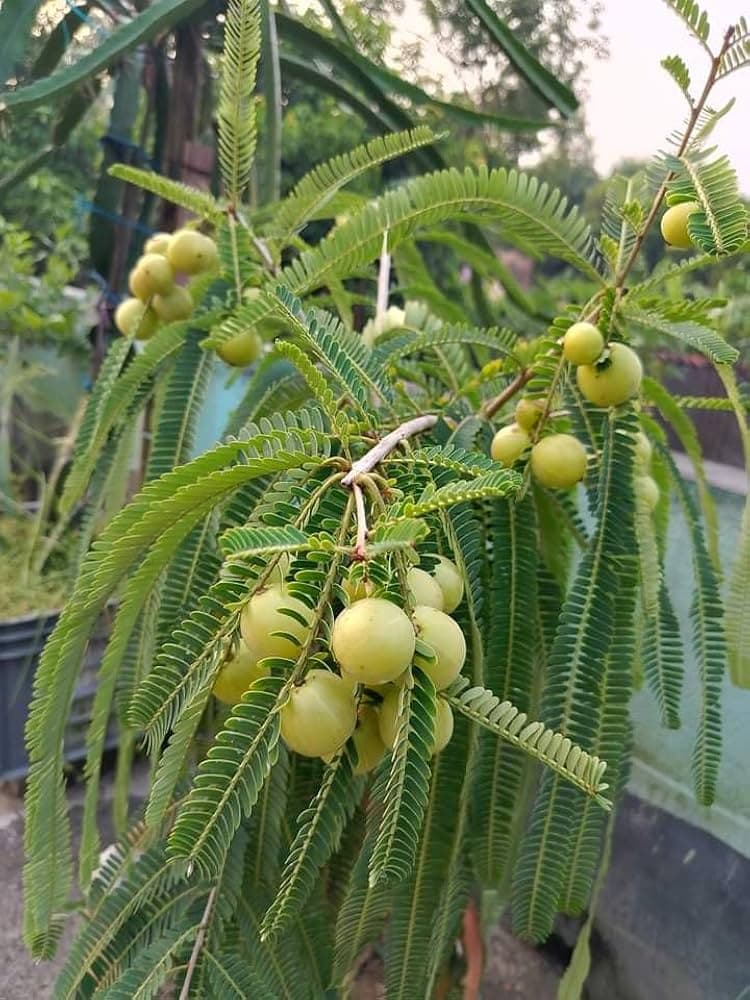
It is a large deciduous tree with greenish-grey or red bark, peeling off in scales.
Emblica officinalis Gareth · Euphorbiaceae
It is a large deciduous tree with greenish-grey or red bark, peeling off in scales.
Scientific Name
Emblica officinalis Gareth
Family
Euphorbiaceae
Hindi Name
Amla
Used Part
Phala (Fruit)
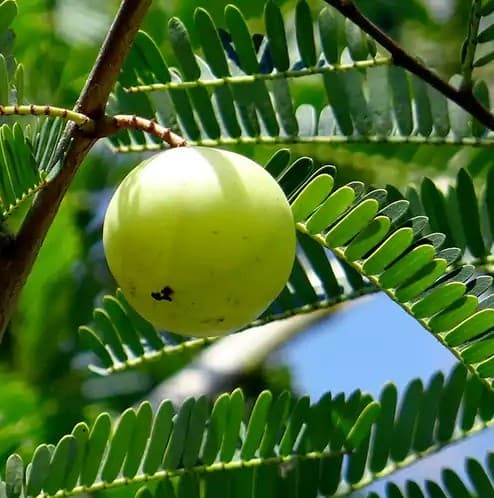
Morphology and field-identification notes as documented in our Dravyaguna library.
It is a large deciduous tree with greenish-grey or red bark, peeling off in scales. Leaves-pinnate, distichously close-set, linear-oblong, obtuse. Flowers-densely fascicled along the branchlets, yellowish; males on slender pedicles, females sub-sessile, Fruite- berry, depressed globose, succulent, yellow or pink when ripe, obscurely 6-lobed. Seeds-trigonous. (flowers in Feb.-May and fruits in Oct.-April)
The five-fold framework Ayurveda uses to describe a drug — Rasa, Guna, Vipaka, Veerya and its effect on the doshas.
Amla, Madhura,Katu,Tikta,Kashaya ( Lavan Rahita Pancharasa)
The primary taste perceived on the tongue.
Ruksha,Laghu, Sara
Physical and energetic attributes of the dravya.
Madhura
Taste that emerges after complete digestion.
Tridoshahara
Effect on Vata, Pitta and Kapha doshas.
Sheeta
Heating (ushna) or cooling (sheeta) energy.
Rasayana, Pramehaghna, Jwaraghna, Vrashya, Dahahara, Chardighna, Shophaghna, Ruchya, Medohara, Bhagna Sandhanakara, Keshya, Chakshushya, Kushthaghna
How modern science maps onto the classical understanding of this dravya.
Pharmacological Action
Immunomodulator, Antioxidant, Antiulcerogenic, Anticarcinogenic, Antihypercholesterolaemic, Pancreatoprotective, Antimicrobial.
Phytoconstituents
Fruit-Ellagic acid, Amlaic acid, Phyllantine, Phyllantidine, Zeatin, Zeatin nucle-otide, Zeatin riboside, Benzenoid, Chebulic acid, Chebulinic acid, Chebulagic acid, Gal-lic acid, Ethyl galate, í-glucogatin, Digallic acid, Emblicol, Phyllemblic acid, Ascorbic acid, Triterpene, Lupiol, Phyllemblin, Flavonoid, Kaempheral, Rutin, g-Sitosterol, Tan-nin (28%), Carbohydrates, Protein, Fat, Calcium.
Classical Ayurvedic indications drawn directly from the Dravyaguna tradition — paired with the preparations recommended in shastra.
01
Fresh Amalaki juice mixed with Haridra taken every day will help treat Prameha (Diabetes).
02
Amalaki powder mixed with honey is effective in Pandu roga (Anaemia).
03
Amalaki churna mixed with more quantity of Madhu (honey) and Sharkara (sugar) given as a Virechaka (purgative) is very useful in Raktapitta (Bleeding disorders).
04
Juice of Amalaki and Kapitha mixed with Pippali churna and Madhu (honey) controls Hiccoughs.
05
Decoction of Amalaki and Haridra are very useful in Vatarakta (Gouti Arthritis).
Always consult a qualified Ayurvedic physician before using any herb therapeutically. Dose, anupana and Prakriti-specific suitability matter.
Yoga / Kalpana
Common Ayurvedic preparations where Amalaki is a key ingredient.
Shastra Pramana
वयस्यामलकीवृष्या जातीफलरसं शिवम् । धात्रीफलं श्रीफलं च तथामृतफलं स्मृतम् । त्रिष्वामलकमाख्यातं धात्री तिष्य फलाऽमृता ।। (भा.प्र. हरीतक्यादि वर्ग-38) हरीतकी समं धात्रीफलं किन्तु विशेषतः । रक्तपित्तप्रमेहघ्नं परं वृष्यं रसायनम् ॥ हन्ति वातं तदमलत्वात्पित्तं माधुर्य शैत्यतः । कफं रुक्षकषायत्वात्फलं धात्र्यास्त्रिदोषजित् ॥ यस्य यस्य फलस्यह वीर्यं भवति यादृशम् । तस्य तस्यैव वीर्येण मज्जानामपि निर्दिशेत् ॥ (भा.प्र. हरीतक्यादि वर्ग-39-41)